
"Artex" is actually a brand name that stuck, the way "Hoover" did. It gets used for any textured ceiling coating, whatever the make.
First: has it been tested for asbestos?
This comes before anything else. Some textured coatings applied before 2000 contained a small amount of asbestos. You can't tell by looking. The Health and Safety Executive lists textured decorative coatings among the places asbestos can be found in buildings.
Left alone and in good condition, it's low risk. The danger comes from disturbing it: sanding, scraping, drilling or trying to pull it off. So if your ceiling is older, have a sample tested by an accredited laboratory before any work starts. Testing isn't expensive, and it tells you which methods are safe to use. Our guide to Artex and asbestos explains how testing works.
Three ways to get rid of a textured ceiling
| Method | When it suits | What's involved |
|---|---|---|
| Skim over it | The ceiling is sound and flat enough underneath | The texture is sealed, filled and skimmed smooth |
| Overboard it | The ceiling is cracked, sagging or very uneven | New plasterboard fixed over the top, then skimmed |
| Remove it | Rarely the best option | Messy, slow and, if it contains asbestos, specialist work |
Skimming over Artex
On a sound ceiling, this is usually the cleanest and most cost-effective route, and it leaves the old coating sealed in rather than disturbed.
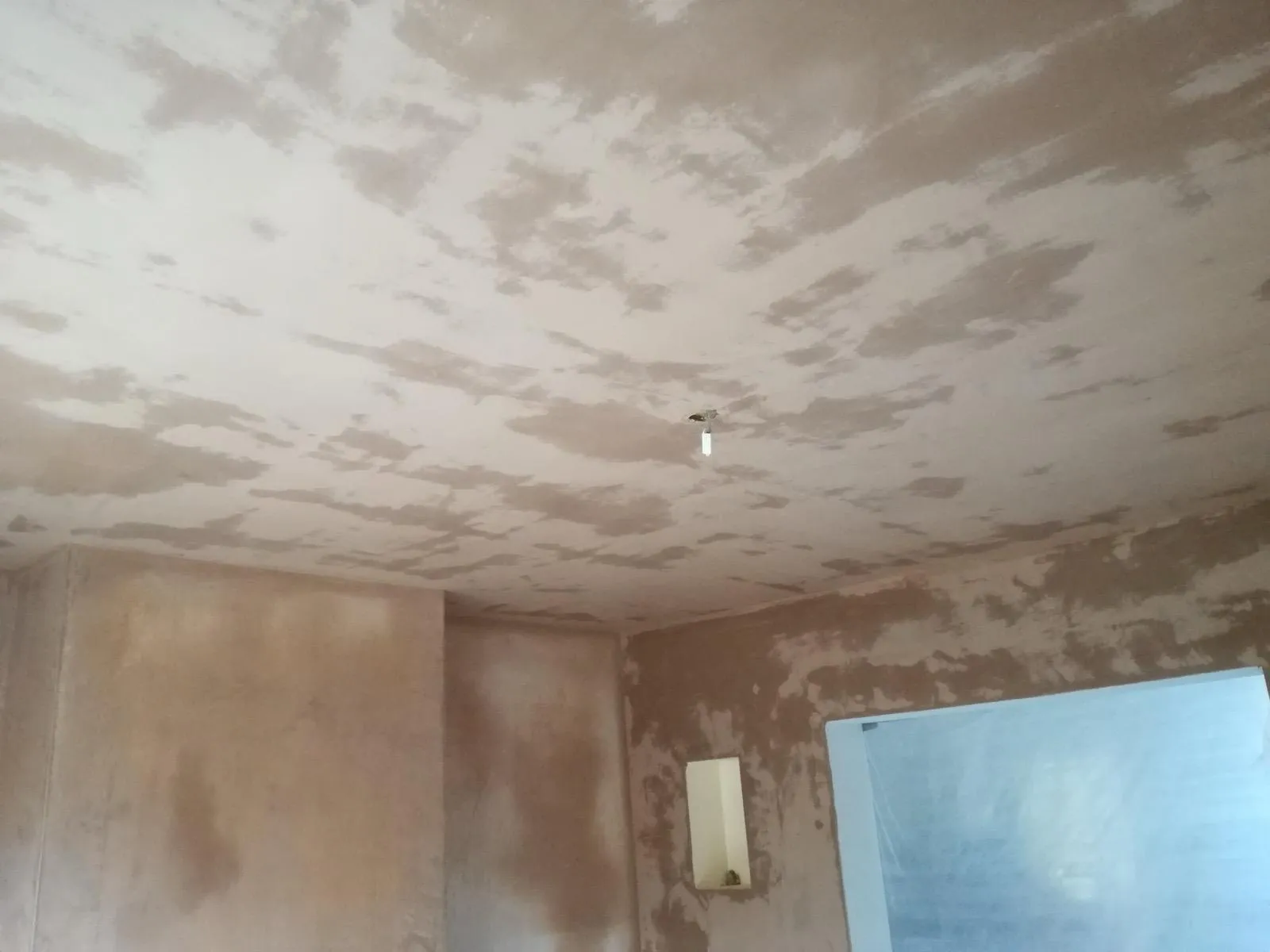
The ceiling is cleaned and the texture is sealed with a bonding primer so the new plaster grips and doesn't dry too fast. Because textured coatings can have quite deep patterns, the first coat of plaster goes on to fill the hollows and bring the surface level. Then a finishing skim goes over the top, trowelled up flat and smooth. On a heavy stipple or deep swirl, that filling stage takes the most time.
If the coating hasn't been tested, nobody should be knocking the peaks off first with a scraper. Sealing and filling over them avoids that.
Overboarding instead
If the ceiling has long cracks, a sag, or the old coating is flaking away, skimming over it just puts a smooth face on a ceiling with problems. In that case, new plasterboard is screwed through into the joists and then skimmed. You get a flat, solid ceiling, and the old one stays where it is. Because it involves fixing through the existing ceiling, testing the coating first still matters. See our page on overboarding cracked ceilings.
Why not just take it off?
Steaming and scraping off a textured coating is slow, filthy work, and the ceiling underneath is often damaged by the time it's done. If the coating contains asbestos, removal should only be done by people trained and equipped for asbestos work. For most ceilings, covering it is the better answer.
What to expect on the day
Ceiling work is the messiest kind of plastering, because everything drips down. The more of the room you can clear, the better. Whatever stays is moved to the middle and covered, and the floor is sheeted wall to wall. Light fittings are taken down or covered. Plan on not using the room until the ceiling is skimmed and has had time to dry, and keep a window open while it does.
Lights and downlights
A smooth ceiling shows much more than a textured one did, especially with light coming in from a window or from downlights shining across it. If you're planning new lights, get the electrician in first so the cables and holes are in place before the ceiling is smoothed. And if the textured coating hasn't been tested, mention that to the electrician too, because drilling it disturbs it.
Textured walls
Textured coatings weren't only used on ceilings. Walls in hallways and stairwells sometimes have them too. The same approach applies: test first, then skim over a sound surface or board over a poor one.
Finishing the room
Once the ceiling is smooth, it's a good time to deal with the rest of the room. Our skimming for walls and ceilings covers the walls, and new coving or cornice gives a neat line where the walls meet the ceiling.
Drying and painting
The new plaster needs to dry fully before you paint, turning an even pale pink all over. Then start with a mist coat of watered-down matt emulsion so the paint takes properly.
Frequently asked questions
Can Artex be plastered over?
Often, yes, if the ceiling is sound. The texture is sealed, filled and skimmed smooth.
Does Artex contain asbestos?
Some older textured coatings do, particularly ones applied before 2000. The only way to know is to have it tested.
Is it safe to scrape off the peaks?
Not unless the coating has been tested and found free of asbestos. Sealing and skimming over the peaks avoids disturbing it.
Should I skim or overboard my Artex ceiling?
Skim if the ceiling is sound and reasonably flat. Overboard if it's cracked, sagging or flaking.
Can you smooth textured walls too?
Yes. Textured walls can be skimmed or boarded in the same way.
Are your quotes free?
Yes. Send us a photo of the ceiling and tell us roughly how old the coating is, and we'll come back to you with a free quote.
Ready to lose the texture?
Send us a photo of the ceiling and let us know whether it's been tested. We'll talk you through the options and give you a free quote. See all our plastering in Haywards Heath.
Back to all services