Three ways to fix plasterboard
| Method | What it's fixed to | Typical use |
|---|---|---|
| Tacking | Timber joists or studs, with screws | Ceilings, stud partition walls, loft conversions |
| Dot and dab | Brick or block, with adhesive | Drylining masonry walls |
| Metal frame or battens | A frame fixed to the wall | Very uneven walls, or where a service gap is needed |
Tacking: boarding ceilings and stud walls
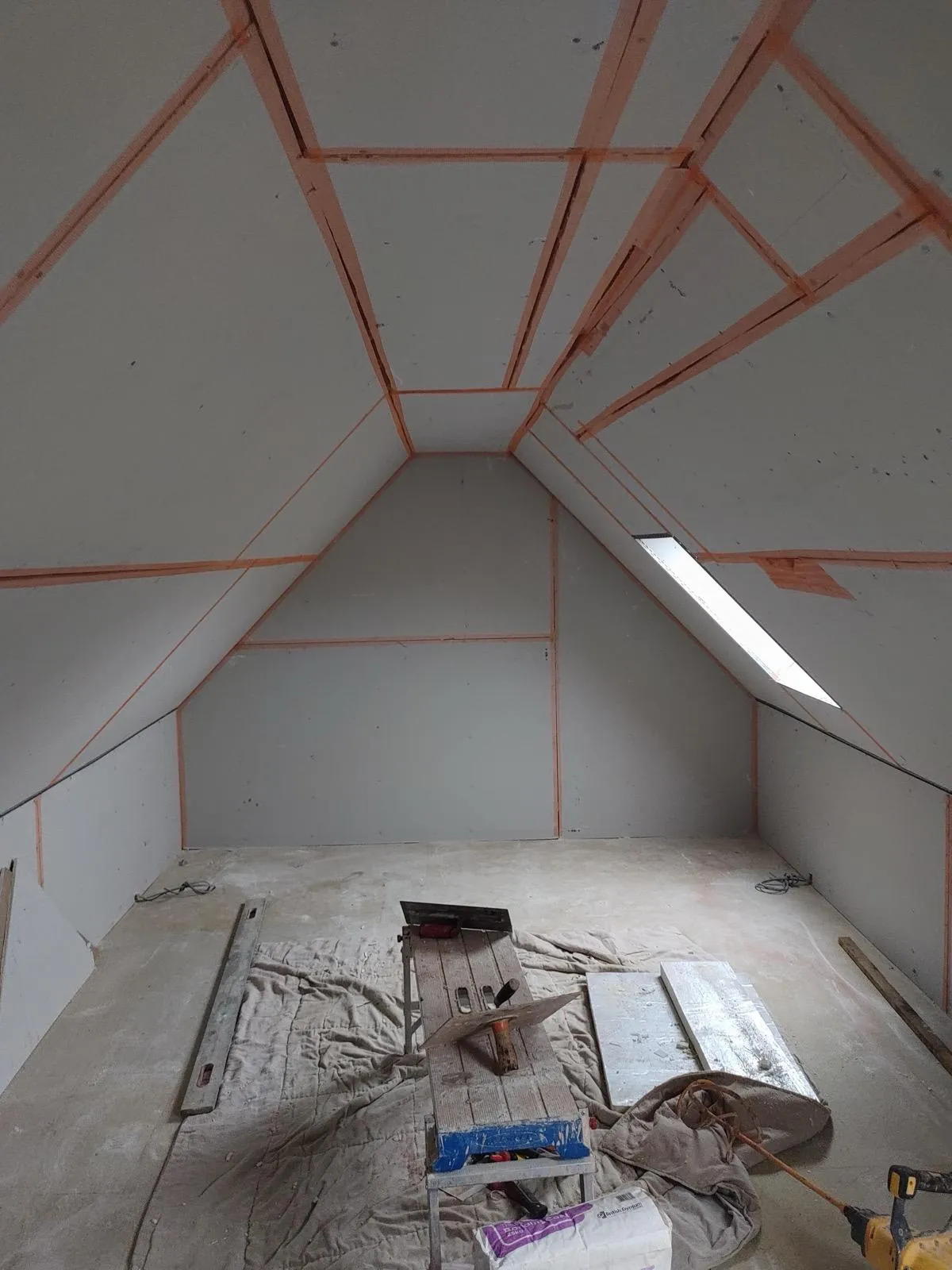
"Tacking" is the trade term for screwing plasterboard to a timber framework, such as ceiling joists or the studs in a partition wall. Boards are cut to fit, fixed at the right spacing with drywall screws set just below the surface without tearing the paper face, which is what holds the screw, and arranged so the joints on a ceiling are staggered rather than lining up in a long straight seam that's more likely to crack. Cut edges are kept to the edges of the room or the corners wherever possible.
On ceilings, thicker board is generally used, and the joists need to be at the right centres to support it. Boarding a ceiling is heavy, awkward work, and it's where shortcuts show first: screws too far apart or missing the joists lead to cracks along the joints within a year or two.
Dot and dab: drylining masonry walls
Dot and dab is a way of fixing plasterboard straight onto brick or block walls without a frame. Dabs of adhesive go on the wall in rows, the board is pressed into them and tapped back to a straight line. A continuous line of adhesive also runs around the edges of the wall and around openings and sockets, which helps the wall perform properly and stops the board sounding drummy at the edges.
It's quick, it gives a flat wall even when the masonry behind isn't, and it avoids the long drying time of wet plaster. There are a few things to know:
- Heavy fixings need planning. Because there's a small gap behind the board, shelves, TVs and kitchen units need suitable fixings into the masonry, or noggins planned in.
- The wall must be dry. Dot and dab isn't a fix for a damp wall.
- Party walls need thought. Boarding a shared wall can affect how sound travels between the houses, so the method should suit the wall.
Choosing the right board
Plasterboard isn't one product. Using the right one for the room matters:
- Standard board for most walls and ceilings.
- Moisture-resistant board for bathrooms, kitchens and utility rooms.
- Fire-resistant board where extra fire protection is needed, such as some ceilings and garage walls.
- Acoustic board where you want to reduce noise between rooms.
- Insulated board with a layer of insulation bonded to the back, for cold external walls.
Boards also come with square or tapered edges. Square-edged boards are made for skimming; tapered-edge boards are designed for taping and jointing without a skim. For a skim finish, square-edged board is the usual choice.
Insulated plasterboard and solid walls
On solid external walls, insulated board can make a room noticeably warmer. It does reduce the room size slightly, and it needs detailing carefully to avoid condensation forming behind it. The Energy Saving Trust explains the options for insulating solid walls, inside and out. Mention it when you get in touch if you're considering it.
Before the boards go on
Get the first fix done first. Electrical cables and back boxes, pipework and any noggins for heavy items need to be in place before the boards cover the wall or ceiling. Back boxes should be set to the right depth so the sockets sit flat once the wall is skimmed.
Finishing the boards
Once the boards are up, the joints are taped with scrim and the whole surface is skimmed in two thin coats to give one smooth, continuous finish. Angle beads go on the external corners. See our page on skimming walls and ceilings for how that part works.
Where boarding comes in
Boarding is part of most bigger plastering jobs: extensions, loft and garage conversions, new partition walls and renovations. See our pages on plastering for renovations, overboarding old ceilings and internal wall and ceiling plastering.
Frequently asked questions
What's the difference between dot and dab and traditional plastering?
Dot and dab fixes plasterboard to the wall with adhesive, then the boards are skimmed. Traditional plastering builds the surface up with wet plaster directly on the wall.
What is tacking?
It's the trade term for screwing plasterboard to timber joists or studs, such as on ceilings and stud walls.
Do boarded walls need skimming?
For a plaster finish, yes. The skim hides the joints and screws and gives one smooth surface ready to decorate.
Which plasterboard should I use in a bathroom?
Moisture-resistant board is the usual choice for bathrooms and other damp-prone rooms.
Can you hang heavy things on dot and dab walls?
Yes, with the right fixings into the masonry behind, or with noggins planned in before boarding.
Are your quotes free?
Yes. Tell us about the rooms and send a photo if you can, and we'll come back to you with a free quote.
Need walls or ceilings boarded?
Tell us about the rooms and what you're planning, and send a photo or two. We'll recommend the right method and board and give you a free quote. See our plastering work across Haywards Heath.
Back to all services