
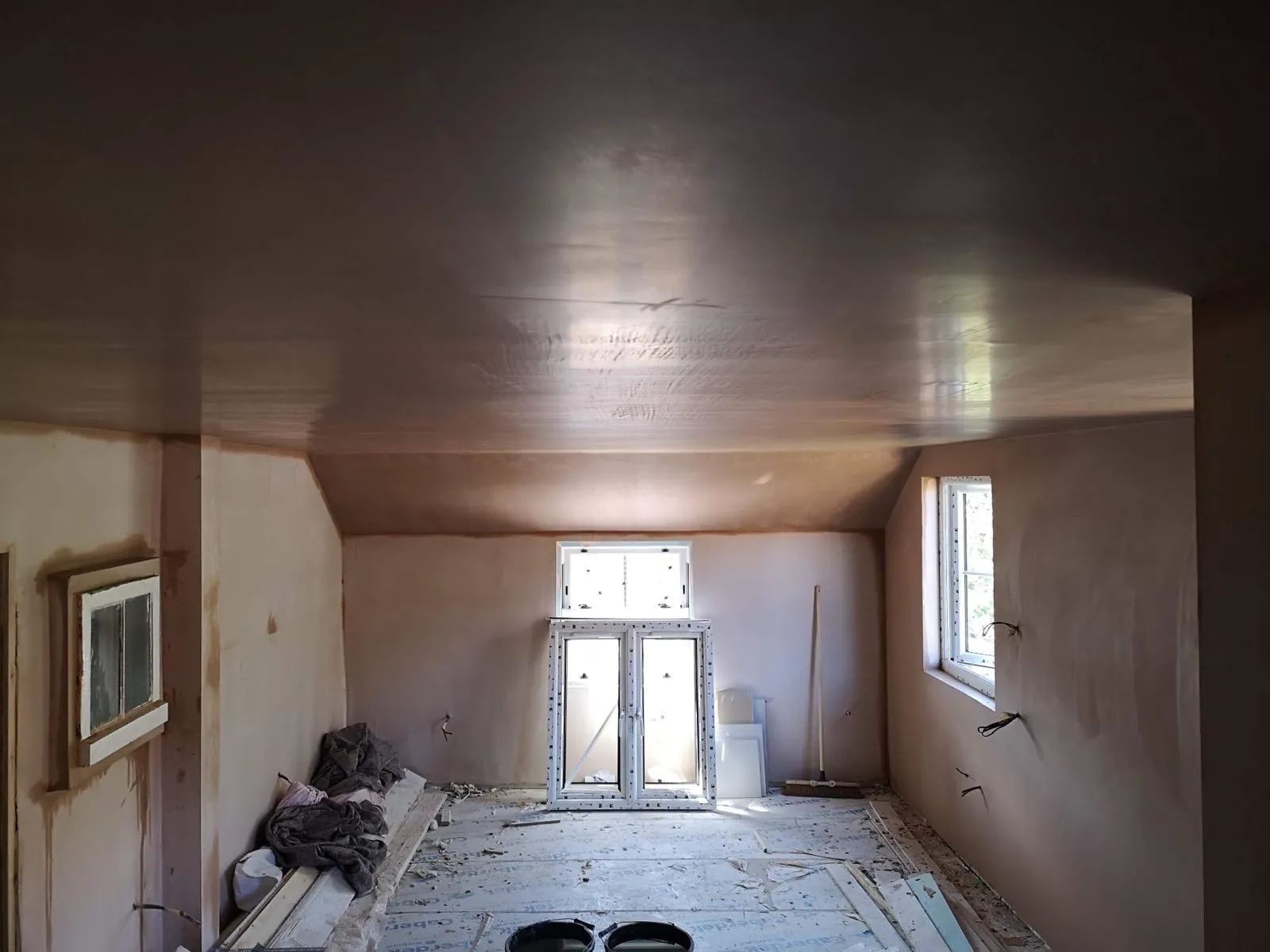
What "float and set" means
The name describes the two coats.
The float coat is the undercoat. It's applied to the bare wall, built out to straighten it, and ruled off flat with a long straight-edge. Before it fully sets, it's keyed with a devil float, which scratches the surface lightly so the next coat grips.
The set coat is the finish. Once the float coat has firmed up, a thin coat of finishing plaster goes on and is trowelled up to a smooth, flat surface, ready for decorating.
On a very uneven wall, a third coat may be needed, which is where the older term "render, float and set" comes from.
Choosing the undercoat
The undercoat has to suit the wall behind it:
| Undercoat | Typical use |
|---|---|
| Gypsum undercoat for high-suction backgrounds | Most common brick and block |
| Gypsum bonding undercoat | Low-suction surfaces such as dense concrete or engineering brick |
| Sand and cement | Walls prone to damp, or where a damp-proofing specification calls for it |
| Lime | Older solid walls built with lime mortar |
Getting this right matters. A plaster that draws too much or too little water from the wall, or one that's too hard for the background, won't bond properly or will crack.
Getting walls straight
Brick and block walls are rarely flat. Part of the skill in float and set is straightening them. Beads go on the external corners and around openings. Where a wall needs it, plaster screeds or dots are set out as guides, and the float coat is ruled off between them with a straight-edge so the finished wall is flat and true, not just smooth over every bump. Window reveals are set square at the same time.
Float and set or dot and dab?
| Float and set | Dot and dab | |
|---|---|---|
| How it's done | Wet plaster straight onto the wall | Plasterboard on adhesive, then skimmed |
| Feel | Solid; no hollow sound | Slight gap behind the board |
| Heavy fixings | Straightforward into solid plaster and masonry | Need planning or suitable fixings |
| Drying time | Longer; a lot of water goes into the wall | Shorter |
| Best for | Uneven walls, older properties, damp-prone areas | Quick drylining of sound, dry walls |
Neither is always better. Float and set gives a solid, durable wall and suits older buildings well. Dot and dab is quicker and drier. See our page on plasterboarding and dot and dab to compare.
After damp-proofing work
If a wall has had a new damp-proof course injected, the damp-proofing company will usually specify how the wall should be re-plastered, often with a sand and cement undercoat containing a salt-resistant additive. That specification should be followed, because standard gypsum plaster on a wall that's still drying out and carrying salts can stain and fail. Tell us about any damp work when you get in touch, and we'll plaster to the specification you've been given.
Older properties
Older solid-walled houses were built with lime mortar and usually plastered with lime. Lime lets moisture move through the wall and evaporate, which is how those houses were designed to stay dry. A hard modern plaster on a damp-prone solid wall can trap moisture and cause problems. Where a wall needs a lime approach, the undercoat and finish should be lime too. Historic England has helpful advice on repairing older homes.
Where it's used
- Extensions where new blockwork needs a solid plastered finish.
- Renovations where old plaster has been hacked off back to the brick. See our page on renovation plastering.
- Walls after damp-proofing, to the specified plaster system.
- Garages and utility rooms where a hard-wearing wall is useful.
- Older houses, where a solid wall finish suits the building.
Drying and decorating
Float and set puts a lot more water into a wall than a skim on plasterboard, so it takes much longer to dry. The finish coat dries to an even pale pink, but the undercoat behind it can still be drying, especially on a thick coat in cold weather. Keep the room ventilated with gentle background heat, avoid forcing it dry with heaters, and don't rush the decorating. Our guide to how long plaster takes to dry explains more. The first coat of paint should be a mist coat of watered-down matt emulsion.
Frequently asked questions
What is float and set plastering?
Traditional two-coat plastering: an undercoat ruled flat onto bare brick or block, then a smooth finish coat on top.
Is float and set better than dot and dab?
It gives a more solid wall and suits older and damp-prone walls. Dot and dab is quicker and dries faster. The right choice depends on the wall.
How thick is float and set plaster?
The undercoat is usually around 10 to 11mm, more on uneven walls, with a thin finish coat of a few millimetres on top.
Can you plaster a wall after damp-proofing?
Yes. The wall should be plastered to the system the damp-proofing specialist has specified.
How long does it take to dry?
Longer than a skim. It depends on the thickness, the time of year and the ventilation. Wait for an even pale colour before decorating.
Are your quotes free?
Yes. Tell us about the walls and send a photo if you can, and we'll come back to you with a free quote.
Walls back to brick?
Tell us about the walls and what's been done to them, and send a photo or two. We'll recommend the right undercoat and give you a free quote. For all our interior work, see our page on interior plastering for walls and ceilings.
Back to all services