
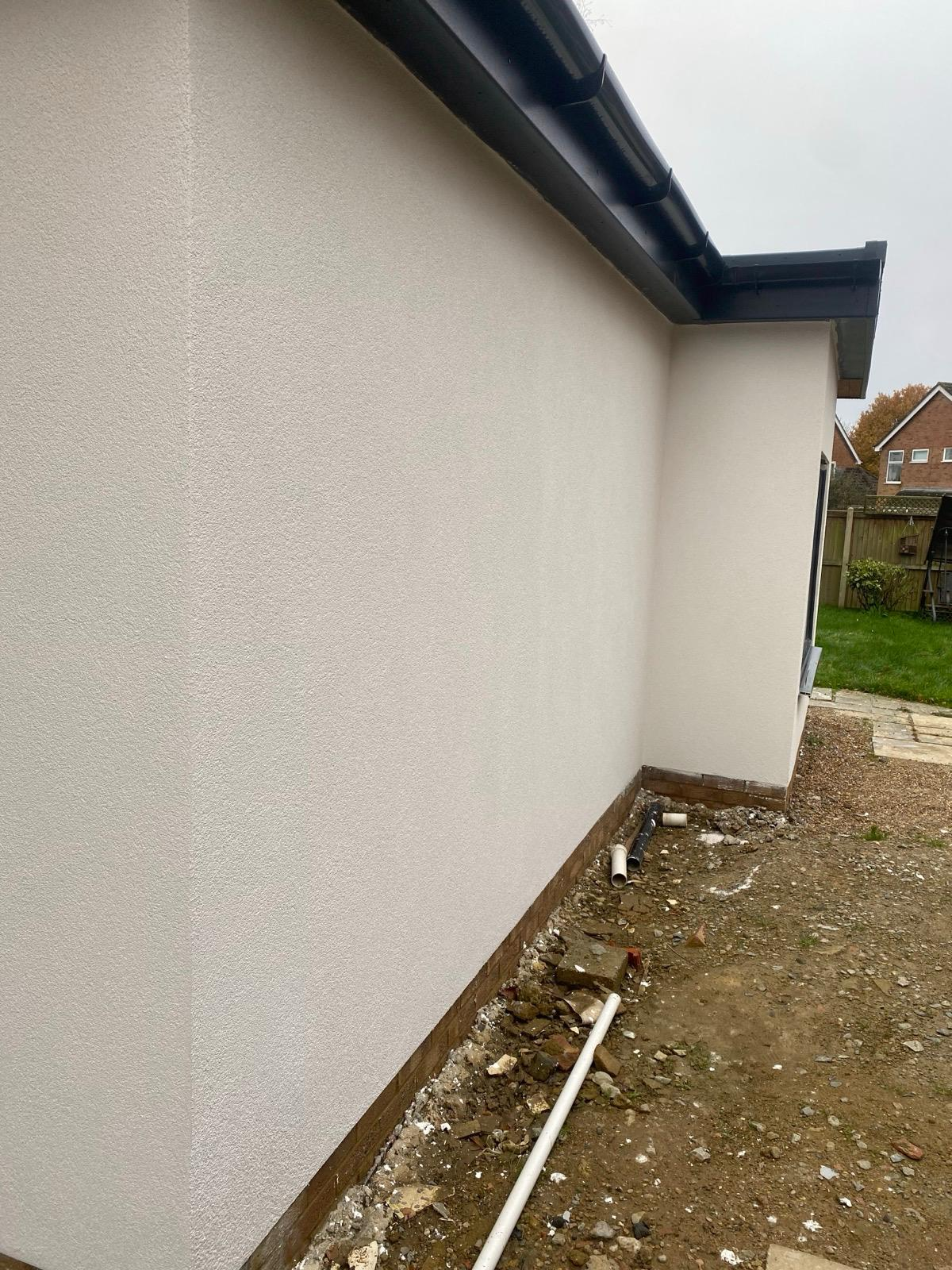
It's also a job where the shortcuts don't show until later. Render that goes on over a poorly prepared wall can look fine for a summer and start cracking by the second winter. Most of what makes a render last happens before the first coat goes on.
Rendering a house: what's involved
The details vary from house to house, but a full render usually runs like this:
- Look at the walls. We check what they're made of, what's on them already and whether there's any damp, cracking or movement to deal with first.
- Scaffold. A whole house needs proper scaffolding, front to back.
- Strip and prepare. Blown or failing render comes off. Loose material is removed, the wall is cleaned down and any repairs are made.
- Fit the beads. Corner beads, stop beads around windows and doors, and a bellcast bead along the bottom of the render.
- Apply the render in the coats the system needs.
- Finish and clear up. Downpipes and fittings go back on, the scaffold comes down and the site is cleared.
Choosing the render
There's no single best render. It comes down to the walls, the look you want and how much upkeep you're happy with.
| Render | What it is | Upkeep |
|---|---|---|
| Sand and cement | The traditional two-coat render, usually painted | Needs repainting every so often |
| Monocouche | A through-coloured render with the colour mixed in | No painting needed |
| Silicone thin coat | A thin, coloured finish over a base coat with mesh | No painting needed; sheds water well |
Sand and cement is still a good, honest render, and on many houses it's the right choice. See our page on traditional sand and cement rendering. Monocouche is popular for a clean, modern look without the repainting; more on monocouche render. Silicone systems give a crisp, textured finish in a wide range of colours and are good at shedding water, which helps on exposed walls; see silicone thin-coat render.
If it's the colour or texture that matters most to you, have a look at our coloured and decorative render page as well.
The details that make it last
Render fails at its edges and openings far more often than in the middle of a wall, so that's where the care goes.
At the bottom, the render should stop above the damp-proof course, finished with a bellcast bead that kicks the water out away from the wall. Render that runs down past the DPC to the ground can carry moisture up into the wall behind it.
Around windows and doors, stop beads give a clean edge and the sills need to project far enough to throw water clear of the render below. External corners get angle beads so they're straight and don't chip. Downpipes, cables and satellite dishes come off and go back on after, rather than being rendered around.
Is your house a good candidate?
Most brick and block houses can be rendered. A few things need a closer look first:
- Existing render. If it's sound and well bonded, it can sometimes be rendered over with the right preparation. If it's hollow or cracked, it needs to come off.
- Pebbledash. Often it can be covered. See our page on covering or repairing pebbledash.
- Damp. Render doesn't cure damp, and it can make some damp problems worse if the cause hasn't been found.
- Older solid walls. Victorian and earlier houses built with soft bricks and lime mortar need to breathe. A hard cement render on that kind of wall can trap moisture. Those walls may need a lime-based approach instead.
Period fronts in Brighton and Hove
Brighton and Hove are known for their Regency stucco: the painted, render-fronted terraces and squares you see along the seafront and in places like Brunswick Town. Those fronts are historic lime stucco, often with mouldings and lined-out joints to look like stone. They need repairing in a way that suits what's there. A modern cement render isn't the right answer for them, and many are in conservation areas or listed, which brings planning controls with it.
Coastal homes
Houses near the coast, in Hove, Shoreham-by-Sea, Saltdean or Rottingdean, take more wind-driven rain and salt than those further inland. On exposed walls, it's worth thinking harder about the render system and paying close attention to the detailing around openings and the base of the wall.
Planning and building regulations
Rendering a house often doesn't need planning permission, but it can, for example in a conservation area, on a listed building or where permitted development rights have been removed. Planning Portal explains when permission may be needed for external wall work, including render. If you're rendering a large part of the outside of the house, building regulations on insulation can also come into it, so it's worth checking with your local building control before work starts.
Weather and timing
Render needs reasonable weather. It shouldn't go on in frost, heavy rain or strong direct sun on a hot day, because it needs to cure steadily rather than freeze or dry out too quickly. That means house rendering is best planned for spring through early autumn, and dates can move if the weather turns.
Frequently asked questions
Do I need planning permission to render my house?
Often not, but it depends on where you live and the type of house. Conservation areas, listed buildings and areas with Article 4 directions can need permission. Check before work starts.
Can you render over existing render?
Sometimes, if the existing render is sound and well bonded. Hollow or cracked render needs to come off first.
Which render lasts longest?
Any properly applied render can last a long time. How long it lasts depends far more on the preparation and detailing than on the brand.
Does rendering stop damp?
No. Render protects a wall from the weather, but if a wall is already damp, the cause needs finding and fixing first.
Do you need scaffolding to render a house?
Yes. A whole-house render needs proper scaffolding for safe access and a consistent finish.
Are your quotes free?
Yes. Send a few photos of the house and we'll come back to you with a free quote.
Thinking about rendering your house?
Send us a few photos of the walls and tell us what you have in mind. We'll talk you through the options and give you a free quote. For everything we do outside, see our rendering in Haywards Heath page.
Back to all services