
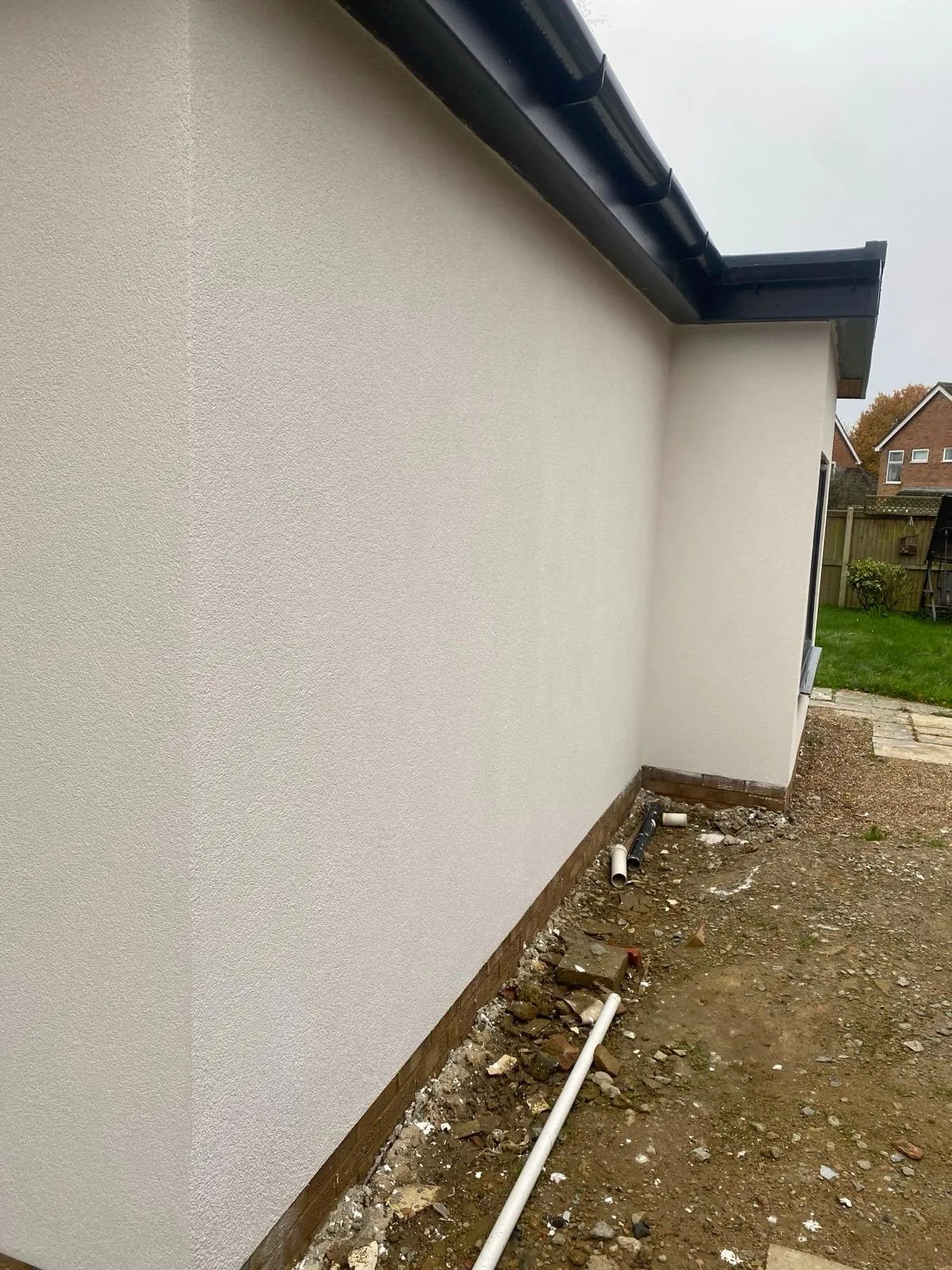
Two ways to get a coloured finish
There are two routes, and they suit different houses and different people.
| Through-coloured render | Painted render | |
|---|---|---|
| Where the colour is | Mixed into the render itself | In the paint on top |
| Products | Monocouche, silicone and other coloured systems | Usually sand and cement |
| Painting | Not needed | Repainted every so often |
| Changing colour later | Harder; needs a coating or new render | Easy; repaint |
| Patching | Harder to blend | Easier to blend |
Through-coloured renders suit people who want a clean finish and don't want to repaint. Painted render suits people who like the idea of changing the colour one day, or who already have painted render elsewhere on the house. See our pages on monocouche render, silicone thin-coat render and sand and cement render.
Textures
Colour gets most of the attention, but texture changes the look just as much.
Scraped finish. The usual finish for monocouche. The surface is scraped back once it has firmed up, leaving a soft, even texture.
Grained finishes. Silicone and similar thin-coat renders come with a grain in them, from fine to coarser. A finer grain looks smoother and more contemporary; a coarser one hides minor unevenness in the wall better.
Float finish. The common finish for sand and cement render that's going to be painted. A fine, even texture that takes paint well.
Smooth finish. Trowelled flat. It looks crisp but shows every imperfection, so it needs a straight wall underneath.
Choosing a colour
A few things are worth thinking about before you settle on a shade.
Look at the street. A colour that sits comfortably with the houses around it nearly always looks better than one that fights them. In Brighton and Hove, for example, the Regency terraces are famous for their pale, creamy stucco, and in many of those streets anything else would look out of place.
See it outside. Colours on a screen or a small chip look very different on a whole wall in daylight. A sample viewed on the house itself, on both a sunny and a shaded wall, tells you far more.
Be careful with very dark colours. Dark render absorbs more heat from the sun, and that puts more stress on the render as it expands and contracts. Many render systems limit how dark you can go for that reason. If you want a strong, dark shade, it's worth checking that the system you're using allows it.
Think about how it will age. Pale colours on shaded, north-facing walls can show green algae over time. Through-coloured renders can also show a pale bloom in the first months as salts work out of the material; it usually weathers away.
Matching an existing colour
Matching a neighbour's house or an existing wall is harder than it sounds. On painted render, it's usually straightforward: match the paint. On through-coloured render, the same product and colour code can still look different next to render that's been weathering for years. If an exact match matters, we'll talk through whether it's realistic, or whether doing a whole elevation will look better.
Painted render: getting the paint right
If you go the painted route, the paint matters as much as the colour. A breathable masonry paint lets moisture in the wall escape; a non-breathable coating can trap it and start to blister and peel. New render needs time to cure before it's painted, often a few weeks depending on the weather.
Planning and colour changes
Changing the colour or type of render can change how a house looks enough to need planning permission in some cases, especially in conservation areas, on listed buildings or where an Article 4 direction applies. Planning Portal's answer to whether you need planning permission to render your house covers the basics, and our guide to planning rules for render in Sussex covers the local side.
Part of a bigger job
Most coloured render goes on as part of a full re-render or a new wall. See our pages on rendering a whole house and rendering extensions and single walls.
Frequently asked questions
Does coloured render need painting?
Through-coloured renders don't. Painted render, such as sand and cement, needs repainting every so often.
Can I have a dark-coloured render?
Sometimes. Dark colours absorb more heat, so many render systems limit how dark you can go. Check before you commit to a shade.
Can you match my neighbour's colour?
On painted render, usually. Through-coloured render is harder to match exactly, especially next to older render. We'll tell you what's realistic.
Can I change the colour of my existing render?
Painted render can simply be repainted. Through-coloured render needs a suitable coating or a new render over it.
Why has my new render gone patchy and pale?
Through-coloured renders can show a pale bloom in their first months as salts come to the surface. It usually weathers away.
Are your quotes free?
Yes. Tell us about your house and the finish you have in mind, send a photo if you can, and we'll come back to you with a free quote.
Ready for a new look?
Tell us about the house and the colour or finish you're considering, and send a photo or two. We'll talk through the options and give you a free quote. For everything we do outside, see our rendering and stucco services.
Back to all services