
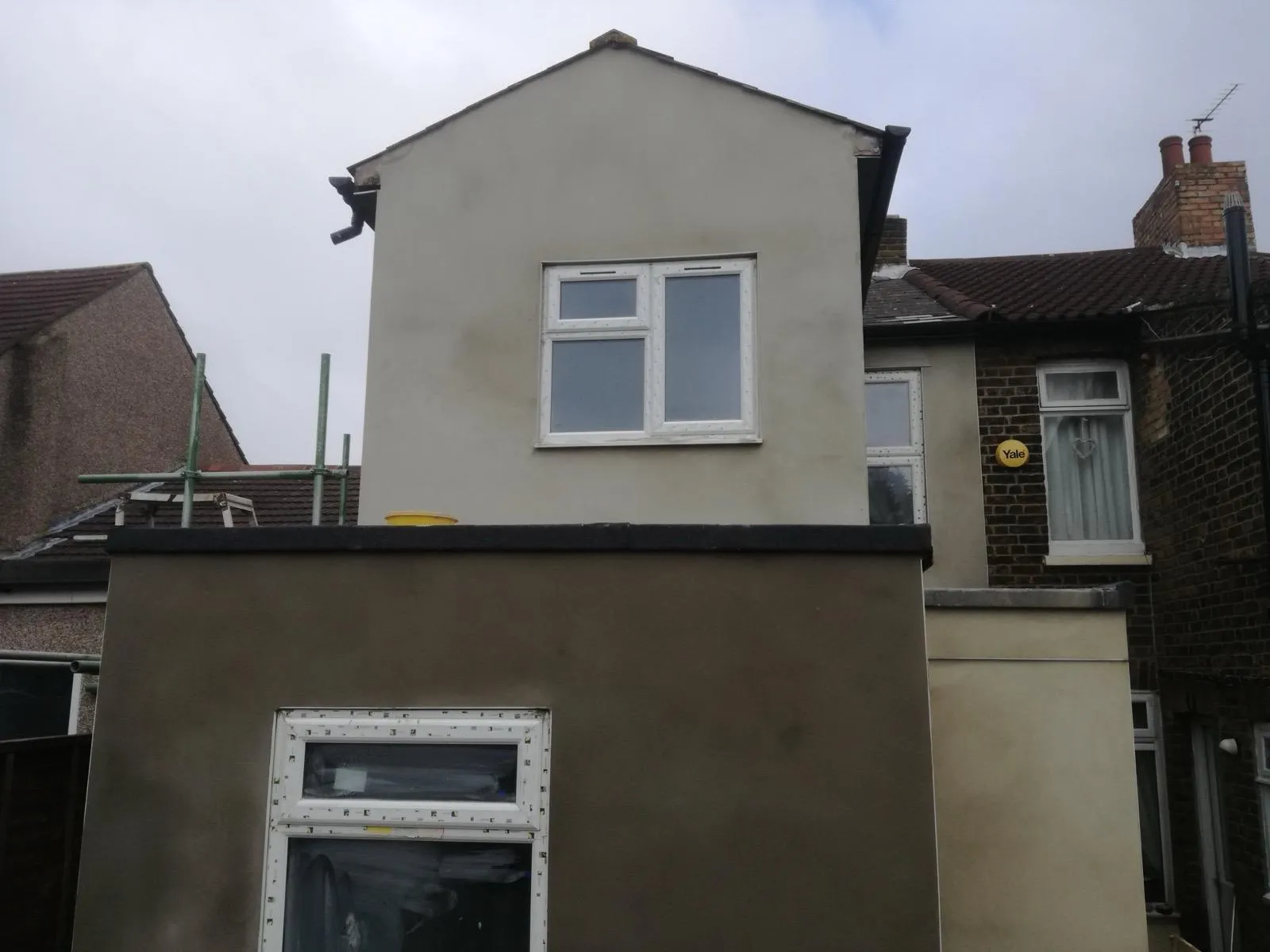
BJL Plastering & Rendering is a renderer based in Haywards Heath. We render houses, extensions and garden walls, repair render that's cracked or blown, cover tired pebbledash, and apply modern through-coloured finishes. We work across Mid Sussex, down to Brighton, Hove and Shoreham, and out towards Uckfield.
Our rendering services
House rendering
A full render or re-render of the whole house, from stripping what's failing to fitting the beads and applying the new finish. This is the biggest exterior job most homes have. Read about rendering a whole house.
External wall rendering
Single walls: a new extension in bare block, a weathered gable end, a side wall or a garden wall. These jobs live or die on how well the new render meets the old. More on rendering extensions and single walls.
Render repairs and maintenance
Cracked, hollow or blown render cut out and patched, and the cause dealt with so it doesn't come back. Often a repair is all a wall needs. More on repairing cracked and blown render.
Sand and cement rendering
The traditional two-coat render, finished and painted. Hard-wearing, easy to patch, and the natural choice where the house already has painted render. More on traditional sand and cement render.
Monocouche rendering
A through-coloured render with the colour mixed in, usually finished with a scraped texture. No painting, and a clean, modern look. More on one-coat monocouche render.
Silicone thin-coat rendering
A thin, coloured finish applied over a base coat and mesh. Silicone renders shed water well and come in a wide range of colours and textures. More on silicone render systems.
Coloured and decorative render
When the colour or texture is the main point, from a soft off-white to a stronger shade. More on choosing a render colour and finish.
Pebbledash covering and repair
Damaged pebbledash patched to match, or the whole lot covered with a smooth modern render. More on covering or repairing pebbledash.
Comparing the main renders
| Sand and cement | Monocouche | Silicone thin coat | |
|---|---|---|---|
| Colour | Painted after curing | Coloured all the way through | Coloured top coat |
| Painting | Repainted every so often | Not needed | Not needed |
| Finish | Float, smooth or textured | Usually scraped | Fine to coarse texture |
| Patching later | Easiest to blend | Harder to match | Harder to match |
| Cost to apply | Usually lowest | Higher | Usually highest |
None of them is the best in every case. The background, the exposure, the look you want and how much upkeep you're happy with all point you one way or another. Our guide to the main render types compared goes into more detail.
Why render fails
Most render failures come back to a handful of causes. Knowing them helps when you're getting quotes, because a good renderer should be talking about all of them.
Poor preparation. Render applied over dirty, dusty or crumbling walls, or over old render that's already hollow, never bonds properly.
The wrong strength. Render that's harder than the wall underneath it can't move with it. It cracks, and on soft brick it can pull the face of the brick away with it.
Bridging the damp-proof course. Render taken right down to the ground lets moisture climb up behind it. It should stop above the DPC, finished with a bellcast bead that throws water clear.
Water getting in behind. Failed sills, leaking gutters and downpipes, and garden walls with no proper coping all let water get behind the render. Once it's there, frost does the rest.
Rushed curing. Render that dries too fast in sun or wind, or freezes before it has set, loses strength and cracks.
Movement. Where an extension meets the house, or two different materials meet, the wall moves. Without mesh or a movement joint, the render cracks along the line.
Repair or re-render?
A wall with a few cracks or a blown patch rarely needs a full re-render. Tap the render with your knuckle: sound render sounds solid, while render that's come away from the wall sounds hollow. If the hollow areas are small, they can be cut out and patched. If large parts of a wall sound hollow, or the render is cracking all over, patching becomes a false economy and re-rendering the elevation is usually better value.
The type of render matters too. Painted sand and cement is easy to patch and repaint, so the repair disappears. Through-coloured renders are harder to patch invisibly, because new material won't look quite like render that's been weathering for years.
Render across Sussex
The houses we render vary a lot from one end of our area to the other.
Down on the coast, Brighton and Hove have some of the finest Regency stucco in the country, in the squares and terraces of Brunswick Town and Kemp Town. That historic stucco is lime-based, often with mouldings and lines drawn into it to imitate stone, and it needs repairing in a way that suits it. Many of those buildings are listed or in conservation areas. Coastal homes from Shoreham-by-Sea and Southwick to Saltdean and Rottingdean also take more wind-driven rain and salt than those inland, so detailing around openings and at the base of the wall matters even more. See our page on rendering and stucco repair in Brighton and Hove.
Inland, around Haywards Heath, Burgess Hill and Lindfield, the mix is broader: Victorian houses, inter-war semis, plenty of pebbledash from the middle of the last century, and newer estates where monocouche and silicone are common. Each needs its own approach.
How a rendering job runs
It starts with a look at the walls, in person or from photos first if you prefer. We'll talk through what's there, what's wrong with it and which render makes sense, and give you a quote. Rendering needs reasonable weather, so most work happens from spring to early autumn, with dates that can move if it turns wet or frosty. On bigger jobs, scaffolding goes up first. Downpipes, cables and fittings come off the wall and go back on afterwards. When the render is on, it's protected while it cures, and the site is cleared when we leave.
Planning permission
Most rendering doesn't need planning permission, but some does: in conservation areas, on listed buildings, and where permitted development rights have been removed by an Article 4 direction. Planning Portal explains when permission may be needed for external wall work, including render. Our guide to planning permission for rendering in Sussex covers the local side.
Looking after render
Render doesn't need much, but a little attention adds years to it. Keep gutters and downpipes clear so water isn't pouring down the face of the wall. Keep soil and paving below the damp-proof course. Repaint sand and cement render before the paint has broken down completely. Through-coloured renders on shaded, north-facing walls can pick up green algae over time, which can usually be cleaned off gently. And deal with small cracks before frost has a chance to open them up.
Inside as well as out
We're plasterers as well as renderers, so if you're planning work inside the house too, see our plastering services in Haywards Heath.
Frequently asked questions
What is a stucco contractor?
Someone who applies and repairs render on the outside of buildings. "Stucco" is the traditional word, especially for historic lime render; "rendering" is what most people call it today.
Is stucco the same as render?
Broadly, yes. Stucco usually refers to traditional lime-based render, like Brighton and Hove's Regency fronts. Render covers modern cement and through-coloured systems too.
Can cracked render be repaired rather than replaced?
Often, yes. Small cracks and blown patches can be cut out and repaired. If large areas are hollow, re-rendering is usually the better option.
How long does render last?
A well-prepared, properly applied render can last for decades. Preparation, detailing and maintenance make far more difference than the product.
Will rendering make my house warmer?
Not noticeably on its own. Render protects walls from the weather, but it isn't insulation.
Are your quotes free?
Yes. Send us a few photos of the walls and tell us what you have in mind, and we'll come back to you with a free quote.
Thinking about rendering?
One wall or the whole house, send us a few photos and tell us what you'd like to achieve. We'll talk you through the options and give you a free quote.
Back to all services