
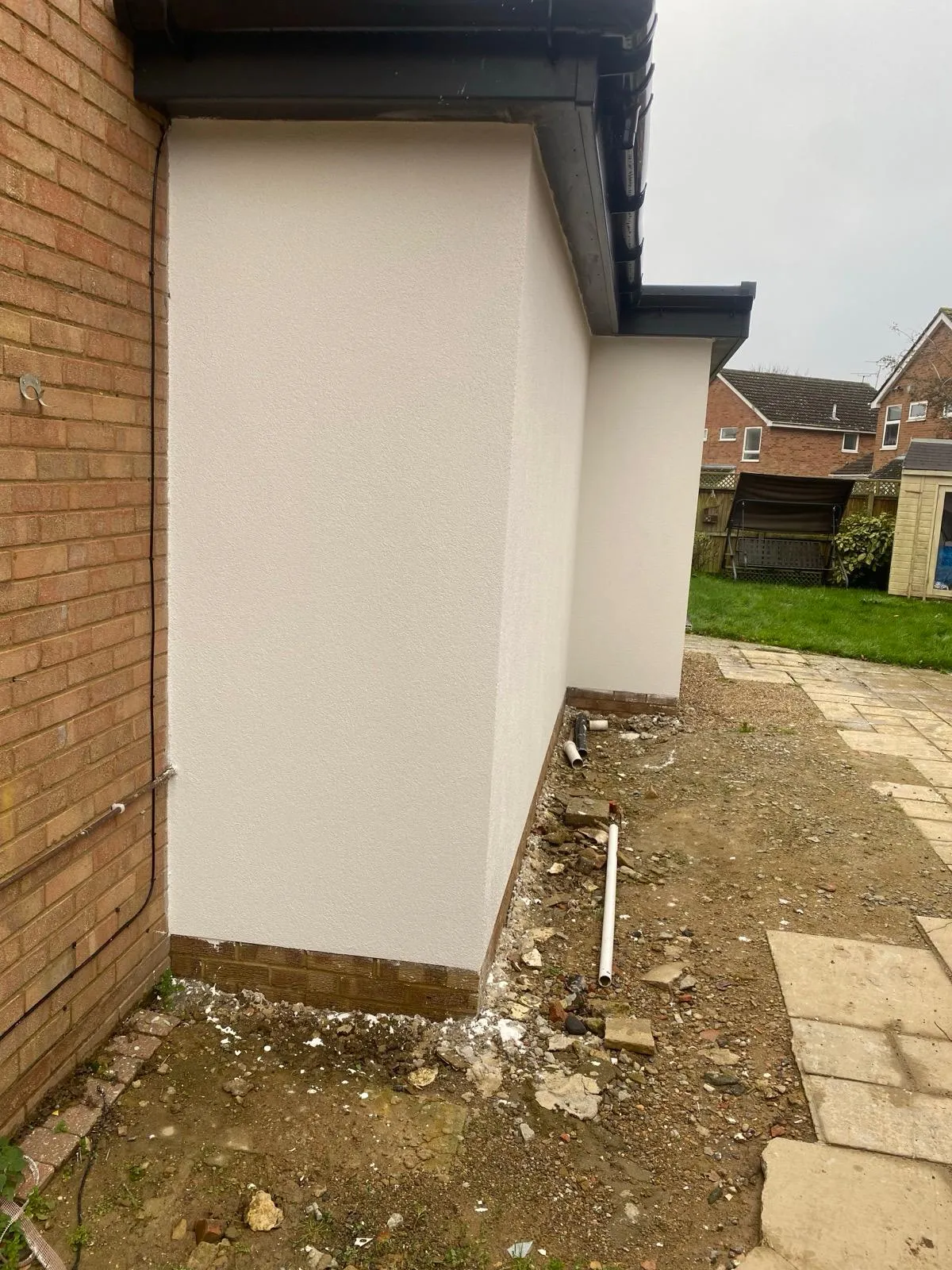
What monocouche actually is
"Monocouche" is French for "single layer". It's a factory-made, cement-based render that arrives as a dry bagged mix with the pigment, aggregates and water-repellent additives already in it. On site it just needs mixing with water.
The name is slightly misleading, because it's normally applied in two passes, the second straight after the first while it's still wet, so the two bond together as one coat. That's then left to firm up, often until the next day depending on the weather, and scraped back with a scraper to open up the texture and leave the finished surface.
Why people choose it
- No painting. The colour is all the way through, so it doesn't need repainting.
- A clean, even finish. The scraped texture is consistent and hides minor unevenness in the wall.
- Water repellent. The additives help the render shed rain while still letting the wall breathe.
- Colour choice. Manufacturers offer a range of colours, from whites and creams to stronger shades.
The downsides, honestly
Monocouche isn't perfect, and it's better to know the drawbacks up front:
- It's harder to patch. A repair years later rarely matches render that's been weathering, so damage can show.
- Colour can vary between batches. That's why a wall needs to be done in one go, with the same batch where possible.
- It can bloom. New monocouche sometimes shows pale patches in its first months as salts come to the surface. It usually weathers away.
- Algae on shaded walls. Pale colours on north-facing walls can turn green over time and need cleaning.
Getting a consistent colour
Most monocouche problems people notice are about colour, not strength. A few things make the difference. Each elevation is planned so it can be finished in one go, because a joint where one day's work meets the next can show. Work stops at natural breaks, such as corners, beads or the edge of a window, never halfway across a flat wall. Mixing is kept consistent, with the same water content each time. And the scraping is timed so the whole wall is scraped at the same stage of set.
Preparing the wall
Monocouche goes onto clean, sound, reasonably flat backgrounds: brick, concrete block, or existing render that's well bonded. Dense or very smooth surfaces may need a primer or base coat first so it can grip. Lightweight blocks and unusual backgrounds need checking against the manufacturer's guidance.
Beads go on before the render: corners, around openings, stop beads at junctions and a bellcast bead along the base so the render stops above the damp-proof course. At the corners of windows and doors, where render is most likely to crack, a strip of reinforcing mesh set diagonally helps spread the stress.
Weather
Monocouche needs steady curing. It shouldn't be applied in frost, in rain, or on a wall in strong direct sun on a hot day, and it needs protecting if the weather turns while it's still green. That's one reason rendering is mostly done from spring to early autumn.
Looking after monocouche
There isn't much to do. Keep gutters and downpipes working so water isn't running down the face of the render, and keep soil and paving below the damp-proof course. If a shaded wall picks up algae, a gentle wash with water and a soft brush is usually enough; check the manufacturer's guidance before using any cleaning product, and keep a pressure washer well away, because a strong jet held close can damage the scraped surface.
Monocouche or silicone?
Both are through-coloured and neither needs painting. Silicone thin-coat render goes on as a much thinner coloured layer over a base coat and mesh, offers a wider choice of colours and textures, and is particularly good at shedding water and dirt. It usually costs more. Monocouche gives a slightly thicker, scraped finish and is often a little cheaper. If you'd like to compare all the main options, see our guide to render types compared.
Over pebbledash or old render
Monocouche can often go over pebbledash or existing render if it's sound. Pebbledash usually needs a levelling coat first so the new render has a flat base. See our page on covering pebbledash.
Planning permission
Changing to a new render type or colour can alter how your house looks, which sometimes needs planning permission, particularly in conservation areas or on listed buildings. Planning Portal covers whether you need permission to render your house.
Frequently asked questions
Does monocouche render need painting?
No. The colour runs right through the render, so it doesn't need painting.
What does monocouche mean?
It's French for "single layer". It's usually applied in two passes that bond together as one coat.
Why does new monocouche look patchy?
New monocouche can show a pale bloom as salts come to the surface in its first months. It normally weathers away.
Can monocouche go over pebbledash?
Often, yes, if the pebbledash is sound. A levelling coat usually goes on first.
Can monocouche be repaired?
Yes, but a repair rarely matches older, weathered render exactly, so patches can show.
Are your quotes free?
Yes. Tell us about your house, send a photo of the walls, and we'll come back to you with a free quote.
Interested in monocouche?
Send us a few photos of the house and tell us the look you're after. We'll talk through colours and options and give you a free quote. For everything we do outside, see our rendering services.
Back to all services