
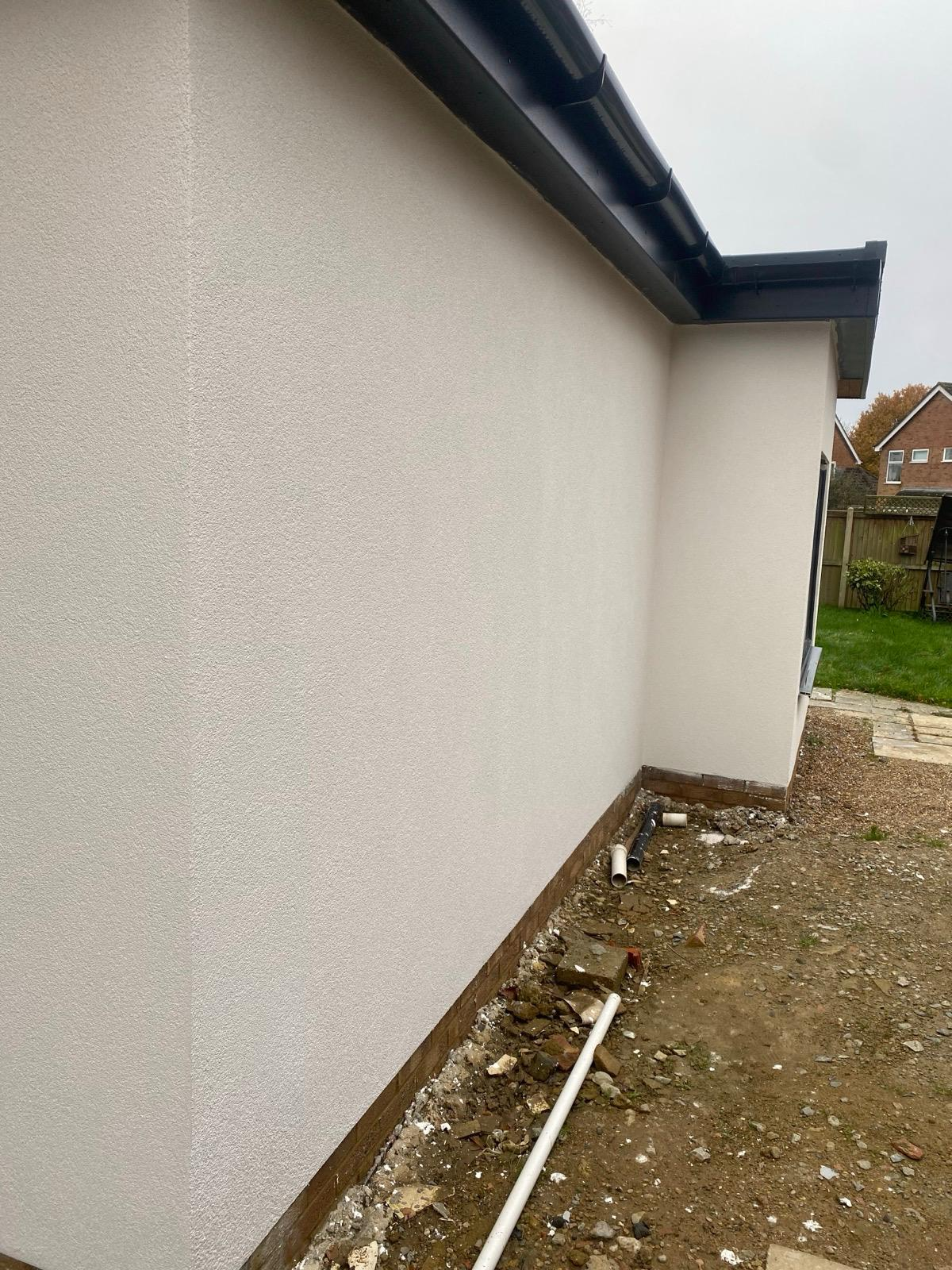
Smaller doesn't mean simpler. A single wall has to sit next to whatever's already there, and the joins between old and new are where render is most likely to crack. Those details get the most attention.
The walls we render
| Wall | What usually matters most |
|---|---|
| New extension blockwork | Matching the house and dealing with the joint between old and new |
| Gable end | Exposure to wind-driven rain, and safe access at height |
| Side or rear elevation | Matching the front, or making the rest of the house look consistent |
| Garden or boundary wall | A proper coping on top, and water getting in from both sides |
| Plinth or base of a wall | Stopping above the damp-proof course and throwing water clear |
If you're thinking about rendering the whole house rather than one wall, our house rendering page covers that.
Rendering an extension
New extensions are one of the most common reasons people need a single wall rendered. The builder has finished the blockwork, the roof is on and the windows are in, and now the outside needs to look like part of the house.
There are a few things to get right. The blockwork should be clean and dry. Where the new walls meet the old house, the two will move slightly differently, so that junction needs reinforcing mesh or a properly placed movement joint, or a crack is likely to open up along it. And the render has to suit the block. Lightweight aircrete blocks are much softer than dense concrete blocks, and a render that's too strong for the background can crack and pull away. The rule of thumb is that render shouldn't be stronger than the wall it's on.
Then there's matching. If the house is already rendered, the new wall needs to sit alongside it without looking like an afterthought.
Matching new render to old
It's worth being straight about this.
A painted sand and cement render is the easiest to blend. Once both walls are painted the same colour, the join largely disappears, as long as the texture is close. Through-coloured renders like monocouche or silicone are harder. Even with the same product and colour, new render won't look exactly like render that's been weathering for ten years. Sometimes the honest answer is that a whole elevation needs doing to get a consistent finish, rather than one wall standing out.
We'll tell you what to expect before you decide. Our guide to the main render types compared is useful if you're weighing up the options.
Garden and boundary walls
Garden walls look simple, but they're one of the harshest places for render. Rain hits both faces and the top, and there's no roof overhead. The most important part isn't the render at all; it's the coping. Without a proper coping that overhangs and throws water clear, water gets into the top of the wall, runs down behind the render and pushes it off within a few winters.
If the wall is on the boundary, talk to your neighbour before work starts, especially if their side will be rendered too or access is needed from their land.
Gable ends and exposed walls
Gable ends tend to face the weather head on and are often the tallest walls on the house, so they need proper scaffolding or a tower. On exposed walls, it's worth thinking carefully about the render system, and paying extra attention to the verge at the top and the junction with the roof, so water can't get in behind the render.
Preparing the wall
Each background needs its own preparation:
- Brick: cleaned down, loose mortar raked out, and a key or bonding coat where needed.
- Concrete block: clean and dry, with any gaps in the joints filled.
- Aircrete block: a render suited to the softer background, often with a mesh layer.
- Existing render: sound render can sometimes be rendered over; hollow or cracked render comes off first.
- Mixed backgrounds: mesh over the joins between materials, so movement doesn't crack the finish.
Beads go on the corners, around openings and along the base, where a bellcast bead stops the render above the damp-proof course and kicks water out away from the wall.
Which render?
On a single wall, the choice is often led by what's already on the house. If the rest of the house is painted render, sand and cement render usually makes sense. For new walls where you want a clean finish with no painting, through-coloured systems like monocouche are worth considering.
Planning
Rendering a single wall often doesn't need permission, but it can in a conservation area, on a listed building or where permitted development rights have been removed. Our guide to planning permission for render in Sussex explains when to check.
Frequently asked questions
Can you render just one wall?
Yes. We render single walls, extensions and garden walls as well as whole houses.
Will the new render match the rest of my house?
Painted render is the easiest to match. Through-coloured renders can be harder, because older render will have weathered. We'll tell you what to expect before you decide.
Can you render new blockwork on an extension?
Yes, once the blockwork is clean and dry. The junction with the existing house needs reinforcing so it doesn't crack.
Can you render a garden wall?
Yes, but it needs a proper coping on top. Without one, water gets in behind the render and pushes it off.
Do I need scaffolding to render one wall?
It depends on the height. A low garden wall won't need it; a gable end will. We'll explain what's needed when we quote.
Are your quotes free?
Yes. Send a few photos of the wall and we'll come back to you with a free quote.
Got a wall that needs rendering?
Send us a photo or two and tell us what's on the rest of the house. We'll talk you through the options and give you a free quote. For all our exterior work, see our rendering and stucco work page.
Back to all services