
We're a plastering and rendering firm based in Haywards Heath, working across Mid Sussex and down to Brighton and Hove.
What a skim actually is
A skim is a thin finishing coat of plaster over a surface that's already sound, such as old plaster or new plasterboard. It goes on in two thin coats, usually just a few millimetres in total. The first coat is laid on and flattened. The second follows while the first is still soft. Then, as the plaster starts to set, it's trowelled up several times, finishing with a light polish to leave a smooth, flat surface.
It sounds simple. The skill is in the timing: trowel too early and you drag the surface; too late and it won't close up. That's the difference between a wall you can paint straight onto and one that shows every trowel mark when the light hits it.
Skim, re-plaster or overboard?
| Situation | Usually the right answer |
|---|---|
| Sound but tired, patched or uneven walls | Skim |
| New plasterboard | Skim |
| Plaster that sounds hollow or is crumbling | Cut out and patch, or re-plaster |
| Bare brick or block | Float and set |
| Cracked or sagging ceiling | Overboard, then skim |
| Textured ceiling in good condition | Seal and skim |
Our guide on whether to skim, re-plaster or overboard goes into this in more detail. For bare masonry, see float and set plastering.
Preparation
Most of a good skim is preparation. We tap the walls to find any hollow areas, because skimming over plaster that's come away from the wall just hides the problem until it cracks again. Loose areas are cut out and patched first, and cracks are taped.
Then the surface is prepared so the new plaster grips and doesn't dry too fast. Old plaster and painted walls draw moisture out of fresh plaster at very different rates, so the right primer or bonding treatment depends on what's there. Damaged or missing corners get new angle beads. Joints between plasterboard sheets get scrim tape.
A few things can't be skimmed over: wallpaper and lining paper need stripping, and flaking paint needs scraping back. Anything fixed to the wall, such as shelves, curtain poles and radiators, is best taken down first.
Skimming ceilings
Ceilings are harder to skim than walls and less forgiving, because the light from a window rakes straight across them. A sound ceiling can be skimmed. A ceiling with a long crack, a sag, or old lath and plaster that's starting to come away is usually better overboarded first. See overboarding a cracked ceiling.
Textured ceilings can often be skimmed smooth too, but older Artex can contain asbestos, so it should be tested before anyone sands or scrapes it. See Artex ceiling smoothing and our guide to checking Artex before work.
Older houses
In older solid-walled houses, the original plaster may be lime. Skimming over sound lime plaster in a dry room is often fine. On damp solid walls, though, gypsum plaster can trap moisture and fail, and the wall may need a different approach. If we think that's the case, we'll say so rather than skim over it.
After the skim
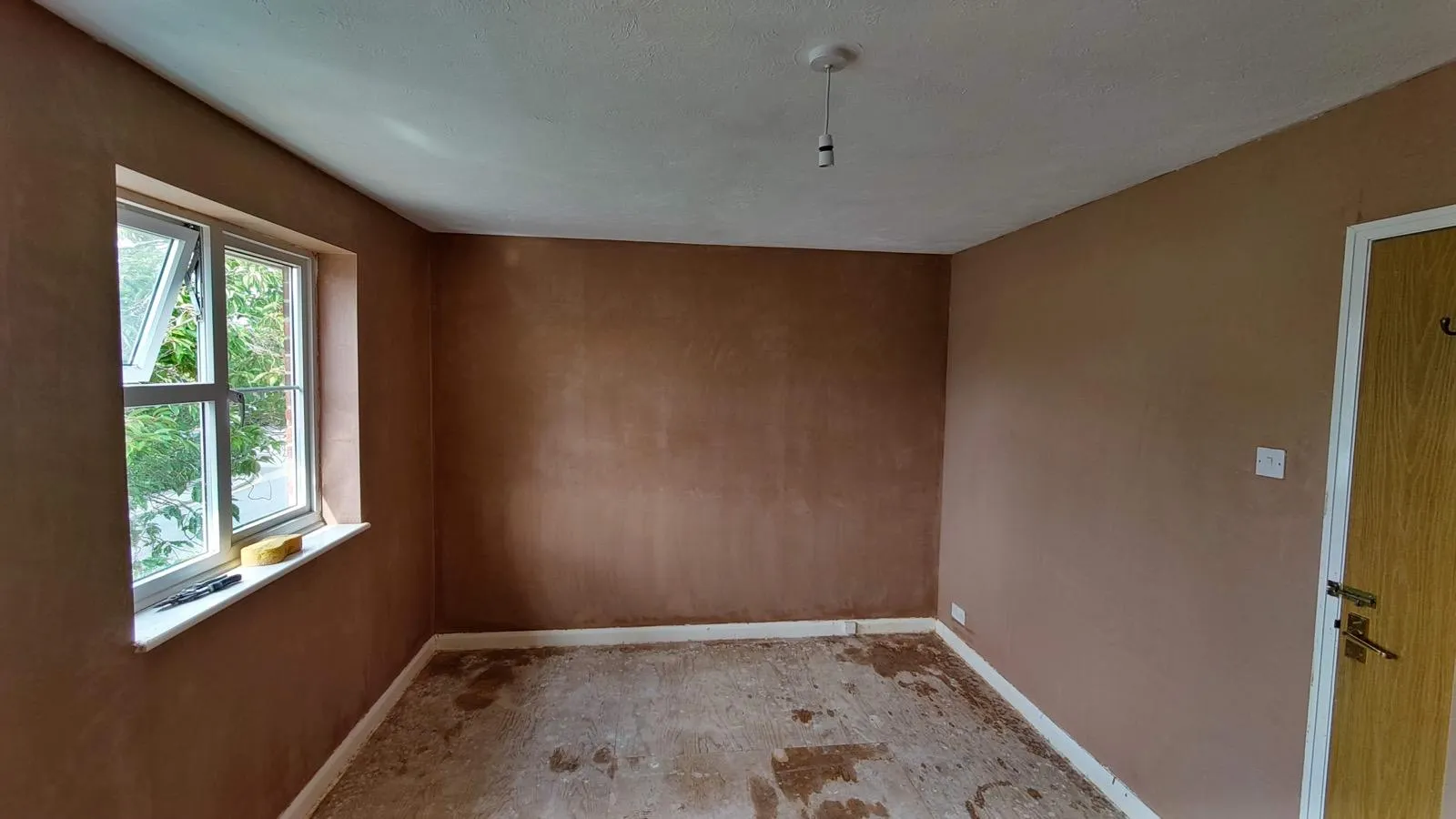
Fresh plaster goes on dark and dries to an even pale pink. Until the whole wall is that colour, leave it. A skim usually dries far quicker than thicker plaster, but it depends on the room, the time of year and the ventilation. Keep a window open and don't crank the heating up to speed it along, because forcing it can cause cracking. Our guide to plaster drying times has more.
The first coat of paint should be a mist coat: watered-down matt emulsion that soaks in and seals the plaster. Vinyl and wipeable paints sit on the surface and can peel off new plaster.
Small areas and repairs
If it's one damaged patch rather than a whole wall, you may only need plaster repairs and patching. If a room is being stripped back as part of bigger works, see renovation plastering.
Planning your job
Before any work on your home, it helps to know what to ask and what to agree. Citizens Advice has a useful guide on what to check before getting work done on your home.
Frequently asked questions
Can you skim over old plaster?
Usually, yes, as long as it's sound. Hollow or crumbling areas need cutting out and patching first.
Can you skim over painted walls?
Often, yes, once loose or flaking paint is removed and the surface is primed so the plaster grips.
Can you skim over wallpaper?
No. Wallpaper and lining paper need stripping first.
How soon can I paint after skimming?
When the plaster has dried to an even pale pink all over. Start with a mist coat.
Do you skim single walls or only whole rooms?
Both. We skim single walls, whole rooms and ceilings, so tell us what you need.
Are your quotes free?
Yes. Tell us about the room and send a photo if you can, and we'll come back to you with a free quote.
Ready for smooth walls?
Tell us about the room and send a photo or two. We'll let you know whether a skim is the right answer and give you a free quote. For all our interior work, see plastering walls and ceilings.
Back to all services